
Think about the most talented person you have ever worked with. The one who could outperform everyone in the room on their best day. Now think about whether they were actually reliable. Whether they showed up consistently. Whether you could count on them week after week, month after month. Chances are, the person who delivered the most over time was not the most talented one. It was the most available one. Think about that.
What elite sport teaches us
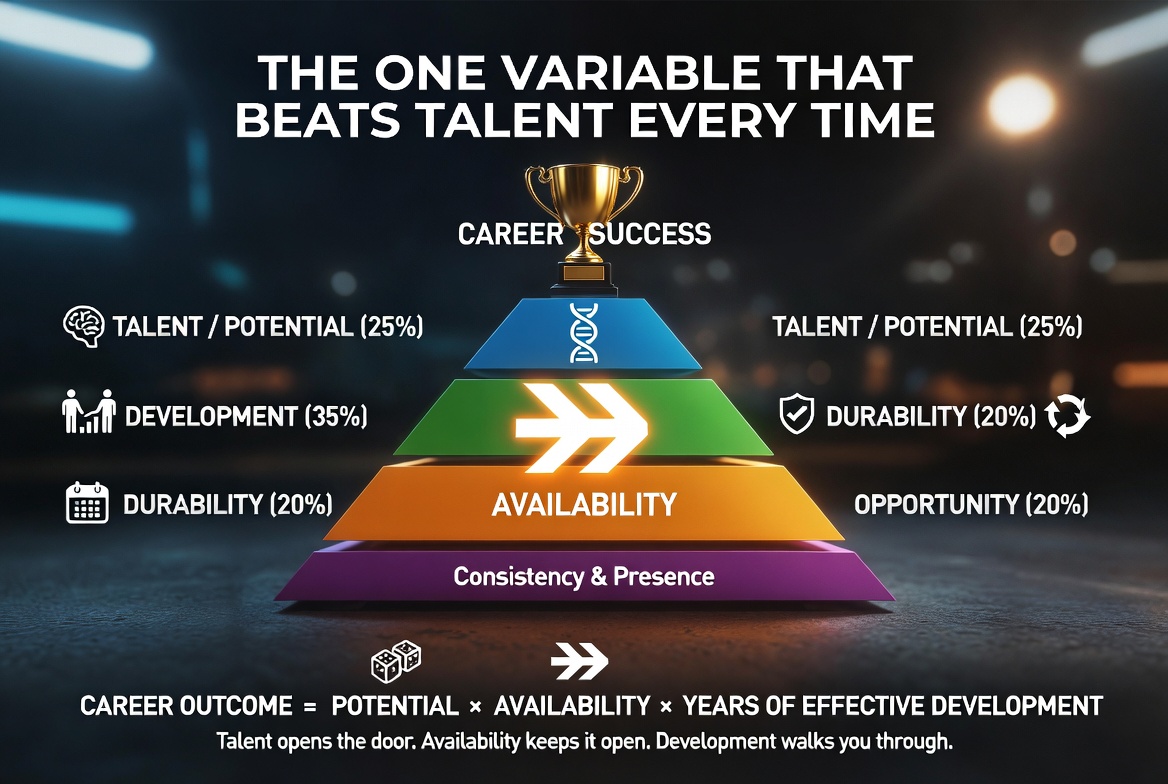
There is a concept in sports performance that I find does not get nearly enough attention as it should: athlete availability. It is exactly what it sounds like. The percentage of time an athlete is physically and psychologically able to train and compete at a high level. You’ll hear everything from talent to development to opportunities (the same goes for a business scenario as well). Yet, rarely do we talk about availability.
By that I mean not injured. Not burned out. Not recovering from something preventable. Actually present and ready to work.
The insight is simple but it changes how you think about performance. Consider two athletes. One is exceptionally gifted but keeps getting sidelined by injuries, fatigue, or mental burnout. The other is slightly less talented but stays healthy and consistent year after year. Over the course of a career, the second athlete accumulates far more quality training and competition time. And that volume of effective practice compounds. Talent only matters if you can actually use it. A player sitting on the treatment table with a torn hamstring is not expressing potential. They are watching it pass by.
The formula looks something like this: career outcome equals potential multiplied by availability multiplied by years of real development. Even if your talent number is high, a low availability score drags the whole equation down. Every missed week has a hidden cost. Those costs stack up quietly over years, and a few avoidable setbacks can quietly derail a career that looked promising on paper.
This applies far beyond sport
Here is where it gets interesting for the rest of us. The same principle works in your career, your health, your relationships, and your daily routines. The person who shows up consistently to do solid work will outperform the brilliant person who is unreliable, distracted, or constantly recovering from self-inflicted chaos. Every time. Think about it in process terms. In any production environment, uptime is everything. A machine that runs at 80% capacity but operates reliably every single day will outproduce a machine that hits 100% in bursts but breaks down every other week. The math is not close. Trust me, and if you dont, take a piece of paper and do some basic math on that.
Your body, your mind, and your career work the same way. Availability is uptime. And uptime is the variable most people ignore while they chase intensity. We glorify the big push. The late nights. The extreme effort (to me that was pushing through weekends, rarely taking breaks, drinking the original red bull from Thailand called Krating Daeng so that I could do excel sheets at 04:00 in the morning). But we rarely talk about the cost of those pushes when they lead to breakdowns, burnout, or extended recovery periods. In Lean thinking, that pattern has a name. It is called overburden, or muri. Pushing a system beyond its sustainable capacity does not increase output. It creates failure points.
Consistency is the actual strategy
The most effective people I have observed, in sport and in business, are not the ones who work the hardest in any single week. They are the ones who manage to sustain a high level of output across months and years without falling apart.
My wife has a large weekly planner on our fridge where we plan our meals with our kids and at the bottom she writes a quote or piece of wisdom for all of us, and this one hit home in regards to this post:
No amount of intensity can make up for the lack of consistency.
That requires something unsexy: maintenance. Rest. Boundaries. Injury prevention, whether the injury is physical or mental. Knowing when to push and when to pull back. Treating recovery not as laziness but as the thing that keeps you in the game long enough for your effort to compound. Is it possible that the biggest threat to your long-term performance is not a lack of talent or effort, but simply the number of days you take yourself out of the equation through avoidable breakdowns? Most people have never done that math. It is worth doing.
The bottom line
Stop optimizing for peak performance in short bursts. Start optimizing for availability over long stretches. Show up. Stay healthy. Protect your ability to keep going. Avoid the preventable setbacks that quietly steal weeks and months from your development. Whether you are an athlete, a professional, or just someone trying to build a better life, the principle is the same. Talent opens the door. Availability is what lets you stay in the room long enough for it to matter.
Key Takeaways
- Availability, the percentage of time you can consistently perform, is the most underestimated factor in long-term success.
- Talent means nothing if injuries, burnout, or preventable setbacks keep pulling you out of the game.
- Consistency beats intensity over any meaningful time horizon, in sport, work, and life.
- Recovery and maintenance are not rewards for effort. They are what keep you available to keep building.
- Optimize for uptime, not peak output. The math favors the person who stays in the room the longest.
If you have made it this far, thank you. I hope this shifts how you think about consistency versus intensity, whether that applies to your training, your career, or just your week. If it hit home, share it with someone who needs the reminder. A like or comment goes a long way. I appreciate you.
Mindset First. Keep thriving.
- Athlete availability concept and career outcome formula inspired by the Carbone Method framework for elite sports performance.
- Muri (overburden) concept from the Toyota Production System. Reference: Ohno, Taiichi. Toyota Production System: Beyond Large-Scale Production. Productivity Press, 1988